Friday, March 9, 2012

Experiment 3: Relationship between wave speed, frequency, and wavelength

Introduction
The purpose of this experiment is to determine how the frequency and wavelength are related by measuring the time taken for a fixed number of waves to pass through a point using a spring with different wavelengths.
In this experiment, a long spring with a wavelength of 6.0m was created by wiggling the spring, and the time taken for 10 waves to pass through a point was recorded. The same procedure was repeated for a wavelength of 3.0m and 2.0m by creating 2 waves and 3 waves in the spring. The time taken was divided by 10 in order to get the period. Then the respected frequency and speed were computed for each trial by using following equations:
ƒ  = 1/T and v = λ/T
where ƒ is the frequency, T is period, v represents speed, and λ indicated wavelength. The speed resulted from the calculation was compared with the speed obtained from the graph. The graph was constructed using Logger Pro.
Figure 1: A spring forming a wavelength of 3.0m wave 

Figure 2: Brief procedure and recorded data
The time recorded was the time taken for 10 waves to pass through a point. Hence, frequency should be 10 times larger than what was written on the board.

Data and Analysis
Table 1: Recorded wavelength and period, along with calculated frequency and velocity
λ(m)
time(s)
T(s)
ƒ(Hz)
v(m/s)
6.0 ± 0.05
9.30 ± 0.050
0.930 ± 0.0050
1.08 ± 0.006
6.45 ± 0.064
3.0 ± 0.05
4.40 ± 0.050
0.440 ± 0.0050
2.27 ± 0.026
6.82 ± 0.138
2.0 ± 0.05
2.56 ± 0.050
0.256 ± 0.0050
3.91 ± 0.076
7.81 ± 0.248

Table 2: Comparison of two wave speeds from computation and graphing
Wave speeds
Average vdata(m/s)
vgraph(m/s)
7.03 ± 0.150
7.509 ± 0.4662
Largest possible
7.18
7.975
Smallest possible
6.88
7.043


Graph 1: Frequency vs. wavelength

Calculations of uncertainties
         1)   ƒ = 1/T
uƒ = √[dƒ/dT x uT]2 = √[(-1/T2) x uT]2 = √(-1/0.9302) x 0.0050)2 = 0.0006 Hz
         2)   v = λ/T
uv = √[( ∂v/T x uT)2 + (v/λ x uλ)2] = √[(-λ/T2 x uT)2 + (1/T x uλ)2] = √[(-6.0/0.9302 x 0.0050)2 + (1/0.930 x 0.05)2] = 0.064 m/s
Discussion
According the graph 1, it was observed that the relationship between frequency and wavelength of the spring were inversely proportional. In this graph, y is frequency, x represents wavelength, and A indicates speed since frequency times wavelength results in a unit of m/s. Therefore, the relationship between ƒ, λ, and v could be presented by ƒ =v/ λ. This was reasonable because as wavelength decreases, more waves could pass through a point in a certain amount of time. Therefore, frequency increases. This relationship was also confirmed by the equations mentioned in introduction. However, as the graph shown, the auto fit line was not smooth. This was because very few data points were recorded, and there were also some errors in recorded time and wavelength. Yet all of these errors were covered by the uncertainties.
As shown in tabl-2, the wave speed computed from the recorded data was within the uncertainty of the speed given by the graph. For instance, the largest possible computed wave speed 7.18 m/s fell within the range of the graph wave speed which was 7.403 m/s to 7.975 m/s. This slight difference in speeds was possibly due to rounding errors and the tendency to auto fit the data by Logger Pro.
Conclusion
                The frequency and the wavelength of a spring were inversely proportional, and the constant in the graph was found to be the speed of the wave. This speed was computed to be approximately 7.03 m/s according the recorded data and 7.509 m/s according to the graph.        

Saturday, March 3, 2012

Experiment 2: Fluid Dynamics

Introduction
The purpose of this experiment was to determine the diameter of the drain hole by using the concept of Bernoulli principle which states that an increase in velocity of the fluid is due to a decrease in pressure.  This statement is shown by the following equation in an incompressible fluid flow:
p1 + ρgh1 + 1/2ρv12 = p2 + ρgh2 + 1/2ρv22
                This experiment was conducted by using a bucket with a small drain hole, 5 gallons of tap water, a 500ml beaker, a meter stick, and a stopwatch. First, the diameter of the drain hole was measured and recorded. Then, a bucket was filled with 3 inches height of water. In fact, this height was 2.3 inches above the drain hole. A beaker with 473 ml mark was put under the drain hole to let the water drain into the beaker. The time taken to empty 473 ml of water from the bucket was recorded. This procedure was repeated six times, and the average time taken was used to compare with the theoretical time taken.  Lastly, the actual diameter was computed based on the measured height of water and recorded time taken. Theoretical time taken and the actual diameter of the drain hole were computed by using the following equation:
V/t=A2gh
in which V represents volume, t is time taken, A indicates area of the drain hole, g is the acceleration due to gravity, and h represents the height of water.
Figure 1: 3 inches height of water in the bucket with a drain hole 

Figure 2: Water from the bucket draining into the beaker


Data and Analysis
Uncertainties of each measured value were assumed to be large so that it took account of various errors in this experiment.

Table 1: Recorded measurements along with calculate values based on these measurements
Recorded measurements
Calculated values
Volume emptied (ml)
473 ± 5
Volume emptied (ft3)
0.0160 ± 0.0002
Diameter of drain hole (cm)
0.60 ± 0.01
Radius of drain hole (ft)
0.0098 ± 0.0016
Height of water (in)
2.30 ± 0.10
Area of drain hole (ft2)
3.0x10⁻⁴ ± 1.0x10⁻⁴
Height of water (ft)
0.192 ± 0.008

Table-2: Comparison of experimental and theoretical time taken for 16 ounces (473ml) of fluid to flow out of the bucket
Trial
Time taken(s)
Average time taken (s)
Theoretical time taken (s)
% Error (%)
1
25.06 ± 1.00
25.30 ± 1.00
15.01 ± 4.93
68.55
2
24.85 ± 1.00
Smallest possible
Largest possible
3
25.24 ± 1.00
21.87
160.9
4
25.36 ± 1.00
5
25.17 ± 1.00
6
26.09 ± 1.00

Table-3: Comparison of the measured and calculated diameter/radius of the drain hole

Measured
Calculated
% Error (%)
Diameter (cm)
0.60 ± 0.01
0.46 ± 0.01
29

Radius (ft)
0.0098 ± 0.0016
0.0076 ± 0.0002

Figure 3: Calculations of uncertainties 


Discussion
                According to table 2, the percent error of the time taken was 68.55%. The experimental and the theoretical time taken were not within uncertainties of each other as shown in table-2. This was because the equipment used in this experiment had high inaccuracy. For instance, the beaker which was marked at 473 ml could contribute larger error since the mark was only an approximation. In addition, using stopwatch to record the time fluid flow could create large deviation from the actual time taken. Since the starting and ending time happened in an instantaneous moment, it was difficult to record the time that matched with the actual beginning and ending of 16 ounces of fluid flow. Thus, there was deviation not only in measurement but also in recorded time. As shown in table-2, the uncertainty of theoretical time taken was almost one-third of its value. Since the theoretical time taken was computed based on several measured values such as height and diameter, uncertainty could be very high. This also contributed to larger percent error.
                However, as shown in table-3, there was smaller percent error, which was 29%, of the diameter of the drain hole. Again, the measured and the calculated values were not within the uncertainties of each other. This error was also contributed due to inaccuracy in the measurement and the recorded time. In addition, the tape that was used to cover the hole was not fully taken out; hence, it possibly prevented water from flowing out of the bucket. This led to longer time taken to empty 16 ounces of water.

Conclusion
                The experimental time taken for 16 ounces of water to flow out of the bucket was 25.30s on average while that of the theoretical value was 15.01s. This resulted in 68.55% error. Besides, the percent error of the diameter of the drain hole was 29% with actual diameter 0.46cm and the measured diameter 0.60cm. 

Wednesday, February 29, 2012

Experiment 1: Fluid Statics

Introduction
The purpose of this experiment is to make a comparison of various methods which are used to calculate the buoyant force to the metal cylinder. The experiment also intends students to understand and apply the Archimedes' principle which states that the buoyant force is the weight of the fluid displaced by an object.
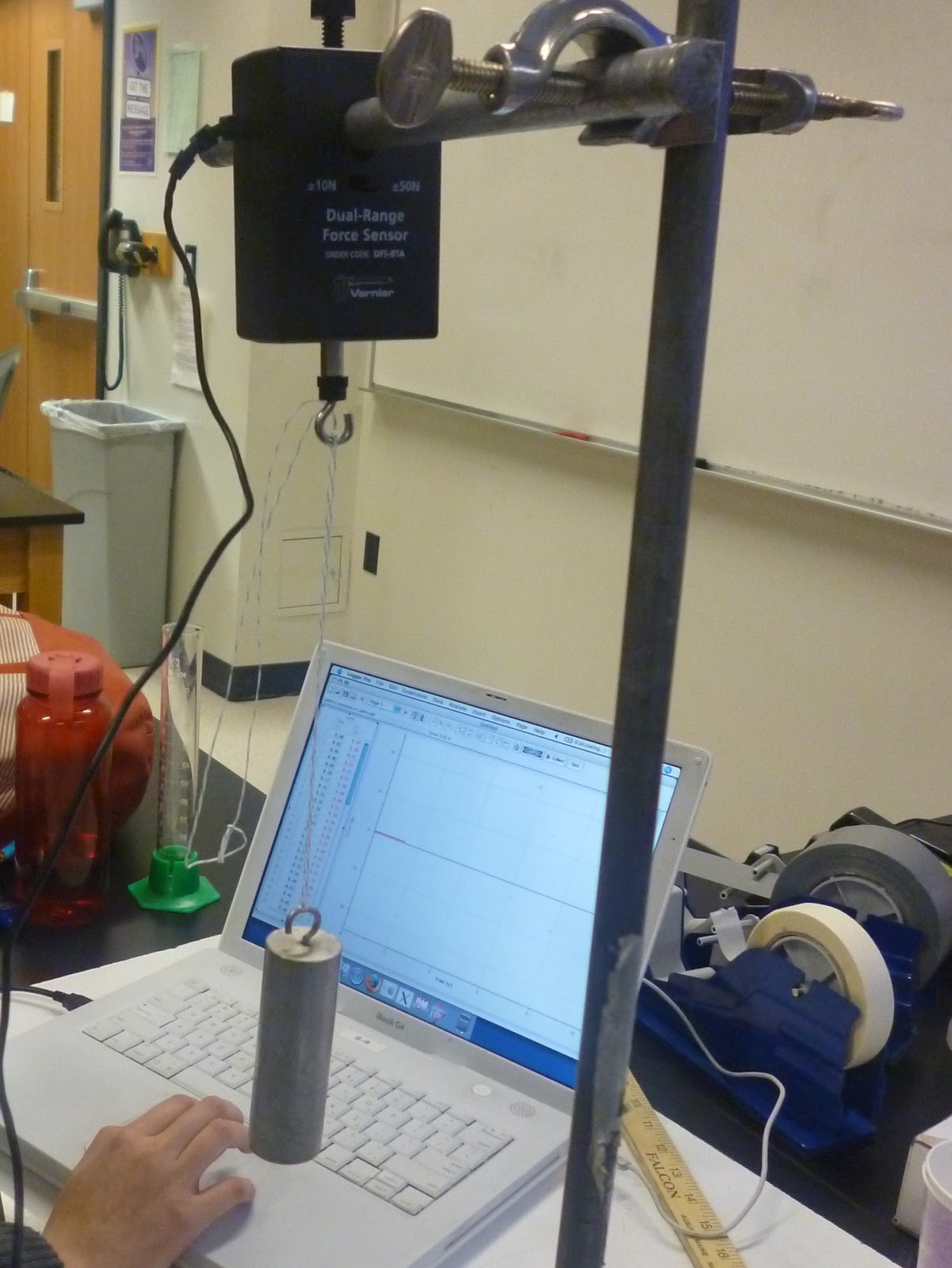
The experiment was conducted in three methods by using a force probe, a string, a beaker, a metal cylinder with hook, a meter stick, and a graduated cylinder. In part A of the experiment, the weight of the metal cylinder in air and in water were measured using the force probe, and the buoyant force was computed by subtracting the weight of the metal in the water to that of the metal in the air. In part B, the mass of a dry beaker was measured using the balance. The cylinder was filled with full amount of water until it stops dripping. Next, the metal cylinder was put into the cylinder, and let the water in the cylinder overflows into the beaker. The mass of the water overflow was calculated by subtracting the mass of the combination of the beaker and the water to the mass of the beaker. The buoyant force was obtained by multiplying the mass of the beaker and the acceleration due to gravity. In part C, the height and the diameter of the metal cylinder were measured, and the volume of the cylinder was calculated. The computed volume was used to calculate the buoyant force, B.
Figure-1: Measuring the weight of the metal cylinder using force probe. This measurement was used in method A.
Figure-2: Overflow of water from the graduated cylinder upon adding the metal into the cylinder. The water overflow was captured by the beaker. This method was used to compute buoyant force in part B.

Data and Analysis
Table-1: Recorded data for each method
Method A
Method B
Method C
Wair = 1.13 ± 0.05 N
Wwater = 0.67 ± 0.05 N
Wbeaker= 0.15086 ± 0.00005 kg
Wbeaker+water= 0.19177 ± 0.00005 kg
h=0.076 ± 0.005 m
d=0.025 ± 0.005 m

Table-2: Comparison of buoyant force, B
Method
Equation used to compute B
B(N)
Largest possible B(N)
Smallest possible B(N)
A
Wair - Wwater
0.46 ± 0.10
0.56
0.36
B
(mbeaker+water - mbeaker)g
0.40092 ± 0.00098
0.40190
0.39994
C
ρgV
0.37 ± 0.29
0.66
0.08

Figure-3: Calculations of uncertainties
Discussion
According to table-2, the values of the buoyant force calculated from different methods were within the uncertainties of each other even though B value in each method was greater or smaller than the others. Yet the results fell within their uncertainties. For instance, the largest possible B in method A was 0.56N and the smallest possible was 0.36N. Both of these numbers were within the values of the other two methods. In same manner, the largest and smallest possible buoyant force in method B and method C were within uncertainties of method A.
Among these three methods, according to table-2, the method B was the most accurate since it had the smallest uncertainty. In addition, as shown in table-1, the devices used in method B measured to more decimal places comparing to the devices used in other methods. Thus, less deviation from the actual values, hence, greater accuracy. In contrast, method C had very great inaccuracy since the only device used in method C was a meter stick. Since everyone reads the measurements differently and the way each person measured were not the same; it led to possible large deviations from actual values. The meter stick also did not read to smaller decimal points which led to greater inaccuracy in the measurement.
If the cylinder had been touching the bottom of the water container in part A, the buoyant force will be larger since there will be less tension detected by the force probe. Since there will also be a normal force adding to an upward force, smaller buoyant force will be required to equal to the same weight of the metal.

Conclusion
               By applying the Archimedes’ principle in this experiment, it was found that values of buoyant force in three different methods were within the uncertainties of each other. Among these methods, method B was the most accurate method.